
<-
Back to
News
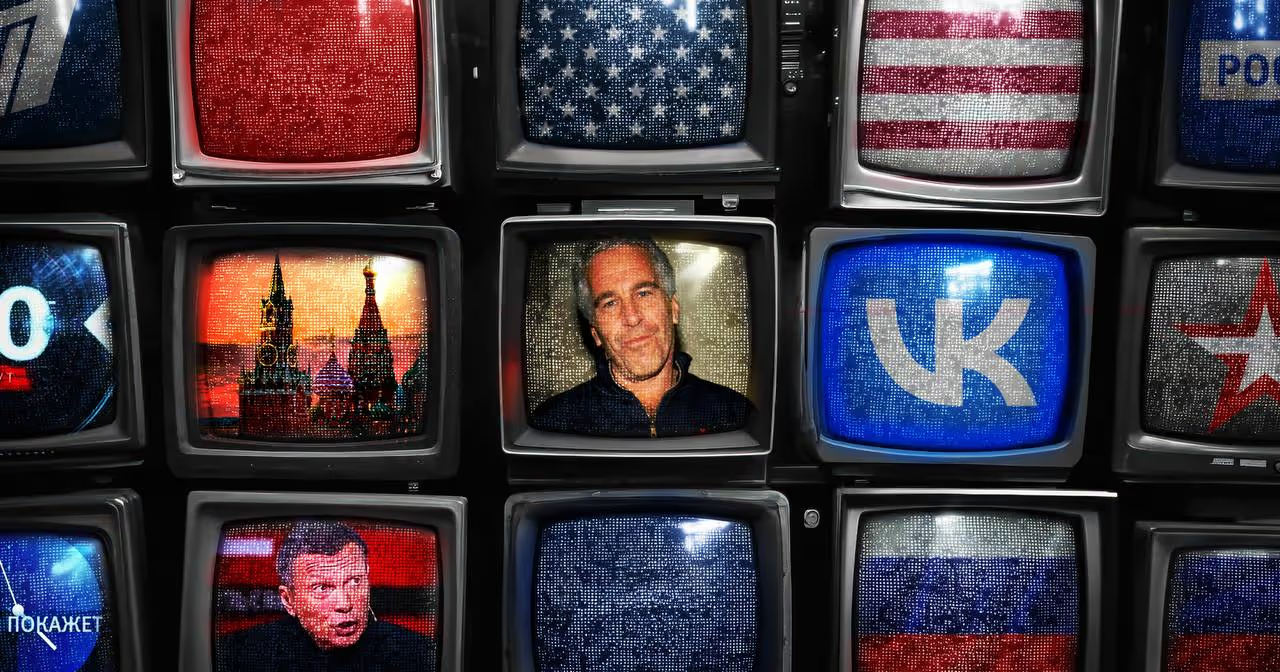
The publication of a new batch of the so-called "Epstein files" on January 30, 2026, became one of the most high-profile media scandals in recent times worldwide. In Russia, however, this topic received specific coverage: state propaganda turned it into an instrument of information warfare, while the general public remained largely indifferent. An analysis of reactions during the period January 30 – February 8, 2026, covering central television (Channel 1, Russia 1, Zvezda, TVC) and regional communities on the social network "VKontakte," reveals several characteristic patterns.
The publication of documents occurred on Friday evening Moscow time. Despite the presence of news programs throughout the weekend, Russian television practically ignored the event during the first three days. This is a typical behavior pattern for Russian state media, which do not function as classical media outlets and do not pick up hot topics "on the fly." The weekend was likely spent forming "temniks" — agreed-upon frameworks for coverage that correspond to the Kremlin's information policy.
The main peak of media activity began the following week. The topic was raised both in news programs and in socio-political talk shows ("Evening with Solovyov," "60 Minutes," "The Big Game," "Time Will Tell"). The presentation was already unified and coordinated.
First, "total moral degradation of the West." This is the central narrative, in which the Epstein topic is used to portray Western elites as a "gathering of perverts, pedophiles, and Satanists." Propagandists spread unverified stories about ritual violence, cannibalism, and murder, leading viewers to the conclusion that the "SMO" is a war against "world evil," and that with "such elites" it is impossible to negotiate.
Second, "Zelensky and Ukraine as part of a criminal network." The thesis of Zelensky's alleged direct involvement in human trafficking and connections to Epstein's network was actively promoted. Epstein's correspondence with the Rothschild family was quoted, where the "coup in Ukraine" (the Revolution of Dignity) was allegedly presented as a business opportunity. Conspiracy theories about "designer children" and genetic experiments on Ukrainian territory were disseminated.
Third, "Trump as a fighter against the system." Propaganda consistently exonerated Trump, emphasizing that although his name appears in the documents, there is no compromising material on him, and he is positioned against "corrupt Democrats."
Fourth, conspiracy theories around COVID-19: allegedly Bill Gates discussed modeling a pandemic with Epstein several years before its onset.
Fifth, ridicule of the "Russian trace." Western press attempts to link Epstein with the FSB/KGB were presented as "absurd" and proof that the West is trying to shift its problems onto Russia.
The overall message of propaganda was reduced to the formula: "Western civilization is in a state of moral decay and is run by criminals, and Ukraine is an instrument and testing ground for their crimes."
The level of aggressive rhetoric in key talk shows deserves special attention. Hosts and experts on Russia 1 and Channel 1 used vulgar language regarding Western leaders and Ukrainian leadership, calling them "perverts," "Satanists," and "non-entities." NATO Secretary General Mark Rutte was called a "prostitute" and "call girl" during his visit to Kyiv. Zelensky was insulted using profanity. The war in Ukraine was presented as a "battle against the spirit of wickedness in high places," and fallen Ukrainians were portrayed as those who died for "the right to hold a candle at Epstein's parties." Such dehumanization goes far beyond commenting on the Epstein files themselves and serves the broader goals of war propaganda.
In contrast to central TV, in regional VKontakte communities the topic of Epstein files found almost no response. Administrators of public groups tried to localize the news, searching for regional connections: the "Voronezh trace," a "model from Nizhny Novgorod," "young women from Omsk," mentions of a modeling agency in Krasnodar, a "Rostov woman at Epstein's parties," and so on.
The public's reaction depended on the region but remained superficial. In Voronezh, the topic was met with irony and jokes about the "city of courage." In Krasnodar, there was a negative attitude toward the city being "exposed." In Rostov and Samara, responsibility was shifted to the women: "they knew where they were going." In Omsk, for some, the participation of local girls in the scandal became a paradoxical source of pride — the city was "noticed."
In the temporarily occupied territories of Ukraine, the topic was integrated into the propaganda context: in Crimea, Putin's words about the "ball of vampires" were quoted, in TO ORDLO — Lavrov's words about the "Satanism of the West" and Vučić's about "diverting attention from Iran."
In several regions, attempts were made to use the topic to discredit Zelensky: in Rostov Oblast, a fake photo of Zelensky in Epstein's embrace was circulated, and in Krasnodar Krai, he was linked to human trafficking. Notably, in the latter case, most commentators recognized the fake, indicating a minimal level of critical thinking even in an environment prone to propaganda.
The general indifference of the regional audience is perhaps the most analytically interesting finding. A significant portion of the public did not know who Epstein was and sought to return to discussing internal problems.
This is paradoxical: the topic of the Epstein files objectively created a safe space for criticizing abstract "elites" — not even Russian, but Western — without the risk of criminal prosecution. However, the audience largely remained silent. There are several likely explanations. First, a defensive mechanism was at work — fear that discussion of the corruption of foreign elites could turn in an undesirable direction for one's own authorities. Second, the topic is distant from Russians' daily problems and does not affect their comfort or economic level. Third, without powerful and systemic support from central media, international scandals simply do not gain critical mass of discussion in regional communities.
Analysis of the coverage of the "Epstein files" in Russia demonstrates a typical model of the Russian propaganda machine's work: controlled delay for the formation of "temniks," coordinated coverage through key narratives, dehumanization of opponents, and conspiratorial context. The topic was used not to inform, but as another tool for legitimizing the war against Ukraine and discrediting the West.
At the same time, the gap between propaganda and public reaction is revealing. The indifference of regional communities indicates both the limited effectiveness of propaganda beyond the prime time of central TV, and the deep atomization of Russian society, focused on survival and internal problems rather than on international scandals.
<-
Back