
<-
Back to
News
An analytical article by Liubov Tsybulska for Ukrainska Pravda.
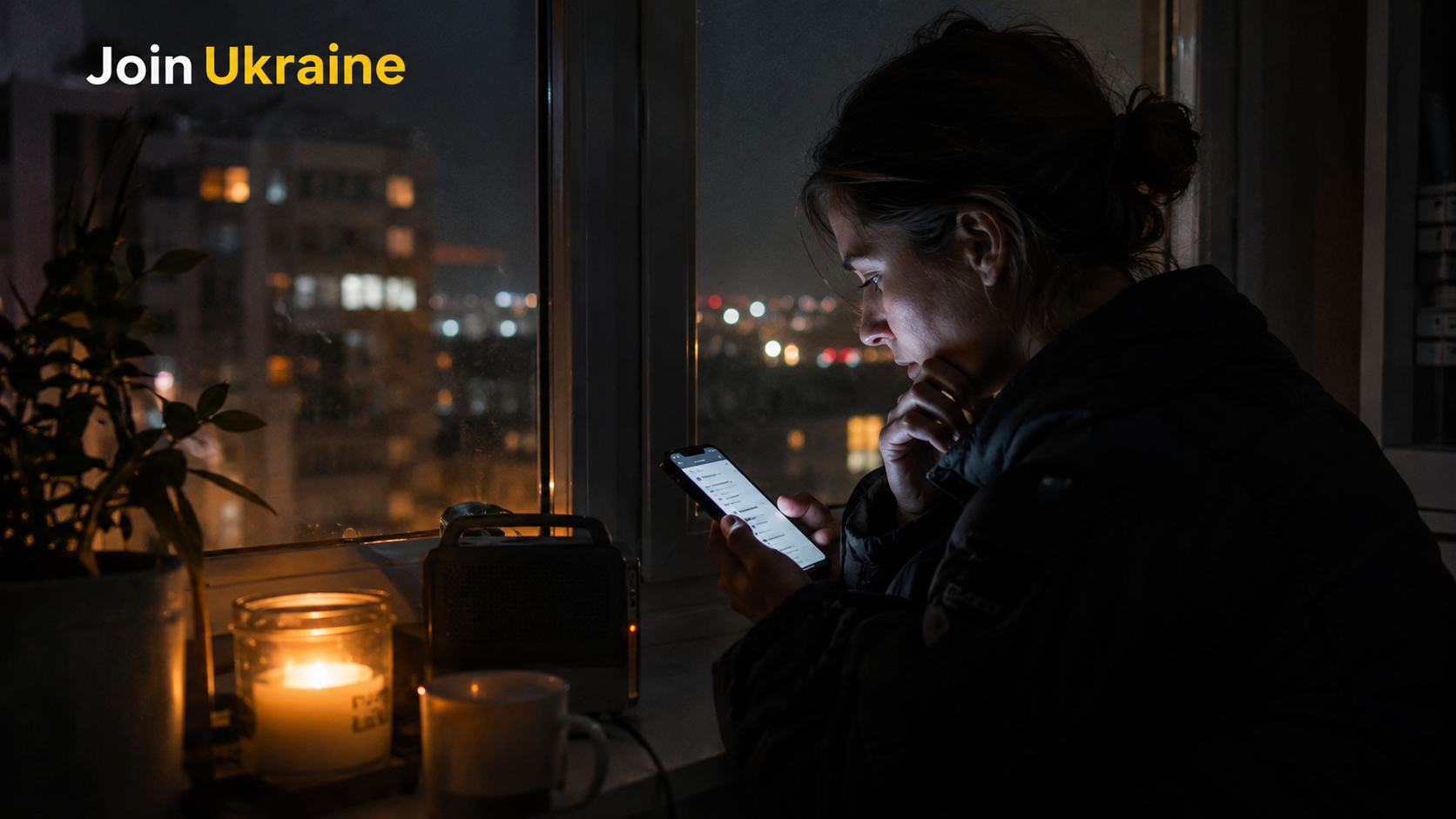
November 1, 2026, 10:47 p.m. The Air Alert app issues a radiation warning for Kyiv. This is followed by alerts about a chemical threat and street fighting, and finally by a Russian-language message warning of a “nuclear alert” across the country. In just seven minutes, users receive 122 fake notifications. In the Lviv region, a technical malfunction even causes some outdoor loudspeakers to broadcast a “Radiation Hazard” signal. The app has been hacked.
This incident highlights two important issues. The first is that cybersecurity is just as much a part of Total Defence as shelters and generators. The app was launched in 2022 by Ajax Systems, at the initiative of the IT company Stfalcon and with the support of Ukraine’s Ministry of Digital Transformation. Officially, it is one of several additional channels for alerting the public. Yet millions of people rely on it every day, meaning that a single successful attack can affect everyone at once.
The second issue raises an uncomfortable question: what if the threat had been real? Do people know how a “Chemical Hazard” alert differs from an air raid alert, and why a basement could potentially be an unsafe place to take shelter in such a situation, given that some toxic gases are heavier than air? Do school principals, heating plant managers and village heads know what to do in the first hour of an emergency: whom to alert, where to obtain protective equipment, and where to evacuate people? Fortunately, this time the incident ended with memes and another wave of jokes about Shchekavytsia.
Ukraine has no shortage of people willing to step up. In February 2022, the country demonstrated an unprecedented capacity for self-organisation: millions of citizens joined volunteer efforts, helped evacuate people, supplied the military and supported critical infrastructure. But a spontaneous outpouring of solidarity, however effective, is not yet Total Defence. Total Defence means that the state, local communities, businesses and civil society share a common understanding of threats, know their responsibilities in advance and are able to work together — with these arrangements formally established in law.
The concept of Total Defence took shape in the wake of the Second World War, which demonstrated that not only armed forces but entire societies are vulnerable. The approach became particularly widespread in Northern European and Baltic countries, which chose to mobilise all available resources for national defence.
For Finland, the defining experience was the Winter War of 1939–1940, when the country managed to resist the Soviet offensive relying primarily on its own resources. Since then, society’s preparedness for crises has been an integral part of national security. Even after the end of the Cold War, Finland maintained this system, built on continuous cooperation between the state, businesses and civil society.
One of the hallmarks of this system is the National Defence Courses. Since 1961, four times a year, members of parliament, public officials, business executives, media representatives and civil society leaders have set aside their regular work for three and a half weeks to learn how the country would function in a crisis and what role each of them would play. More than 10,000 people have completed the national courses, while another 60,000 have attended regional ones. In September 2026, even Suzanne Innes-Stubb, the wife of Finland’s president, took part in the programme.
Sweden followed a different, almost opposite, path. After building a powerful Total Defence system during the Second World War and the Cold War, the country subsequently dismantled much of it. Russia’s aggression against Ukraine prompted Sweden to reconsider this approach and rebuild its preparedness. In 2020, Sweden held the large-scale Total Defence 2020 exercise, involving government agencies, municipalities and the central bank (the Riksbank) in crisis-response scenarios.
Today, Sweden’s model combines military and civil defence. Residents aged 16 to 70 are subject to total defence duty. The updated 2024 edition of the “In Case of Crisis or War” brochure, distributed to every Swedish household, delivers a direct message: help will not reach everyone at once, so people should be prepared to manage on their own for at least a week.
This paradox has at least three dimensions.
The institutional dimension: the powerful wave of self-organisation in 2022 never developed into lasting mechanisms for cooperation between society and the state.
The governance dimension: even when public officials have the authority to act, they are often reluctant to engage with civil society at their own level and instead wait for decisions from above.
The societal dimension: a prolonged war, psychological exhaustion, stress and a growing sense of injustice are gradually eroding people’s willingness to contribute to the country’s defence. In March 2022, 80% of respondents said they were ready to defend Ukraine with weapons, according to the Rating Group. By September 2025, that figure had fallen to 54% among respondents who were not serving in the military, according to the Kyiv International Institute of Sociology (KIIS).
As a result, volunteers, civil society organisations and businesses have made an enormous contribution to the country’s defence. Yet their cooperation with the state still largely depends on personal connections, individual initiative and ad hoc arrangements. Where pre-agreed procedures should be in place, the country still has to rely on someone’s willingness to step in.
Ukraine does not yet have an integrated Total Defence system comparable to those of Finland or Sweden. However, it would be wrong to say that the country lacks the necessary legislation. The Law on the Fundamentals of National Resistance, the Code of Civil Protection of Ukraine and the Concept for Ensuring the National Resilience System outline some of the key areas of this work. The problem lies less in the legislation itself than in the lack of coordination between government institutions, civil society and businesses.
Territorial defence, civil protection, critical infrastructure support and national resilience each have their own responsibilities. But in a crisis, they must operate as one team. When electricity or communications fail, or people need to be evacuated urgently, it is already too late to start making introductions and negotiating who does what.
Who needs to know what to do if the next “Chemical Hazard” alert turns out to be real? The answer is not just the state. Total Defence also depends on the responsibility of every citizen and local leaders.
When an individual, a village library, a school or a heating plant clearly understands its role in a crisis, it can remain operational independently for some time. The resilience of the entire country is built on this kind of local self-reliance.
This does not always require new laws or large budgets. Without waiting for instructions from above, the head of any local community can bring together businesses, civil society organisations and municipal services, agree on how they will act in an emergency and organise joint exercises. This kind of cooperation is at the heart of Finland’s approach to security.
Civil society, meanwhile, is not waiting for Total Defence to become a fully established state system. It is already taking practical steps in that direction.
One such initiative is the Total Defence: Leading Resilient Ukraine programme, launched by the NGO Join Ukraine and the Ukrainian Catholic University. The programme’s partners are Sweden’s Folke Bernadotte Academy (FBA) and the Psychological Defence Agency (MPF).
The pilot course brought together military personnel, public officials, business representatives, media professionals and civil society actors. Discussions, real-world case studies and joint exercises revealed just how differently people from various sectors can perceive the very same threats — and, consequently, how important it is to learn to act together. This work continues with the programme’s second cohort, which began in autumn 2026.
Ukraine does not need to build a society capable of resistance from scratch — it has already demonstrated its strength. The task now is for the state to turn that strength into a coordinated system in which everyone knows their role and no one is left to face a threat alone.
<-
Back