
<-
Back to
News
In a column for Ukrainska Pravda, Liubov Tsybulska, founder of the NGO Join Ukraine, examines what Russia is learning from Ukraine and NATO and why these adaptations may not transform its military system.
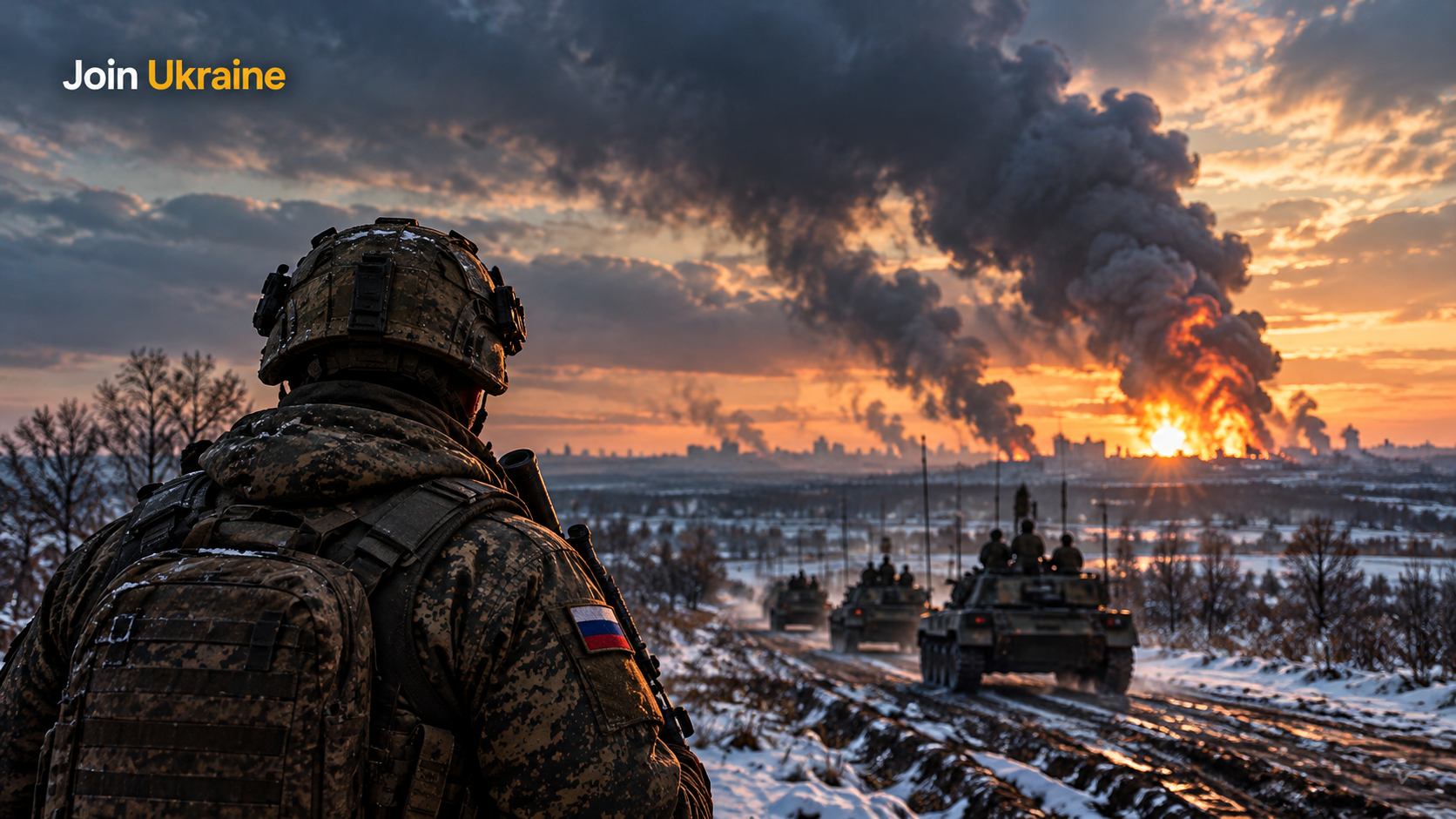
Russia entered its full-scale war against Ukraine with a reputation as one of the world’s strongest militaries. Yet the first weeks of the invasion showed that this assessment was wrong. The reasons for its failures were sought in logistics, equipment, training and motivation. But most of the setbacks stemmed from an inability to make the right decisions on the battlefield.
The Russian military found itself fighting a war in which commanders had to operate without orders from above, or with orders that no longer matched the situation on the ground.
This also exposed the fundamental weaknesses of Russian military education. For decades, it had trained officers to carry out tactical tasks and work with staff documents, but not to think and act independently.
In this respect, Russian and Western (NATO) military training systems differ in ways that go far beyond methods and training procedures. They are rooted in different command cultures and, consequently, in different understandings of a commander’s role in modern warfare.
The findings presented in this article are based on Join Ukraine’s study, How Russia Trains Officers for War: Evolution, Ideology and the Impact of Contemporary Challenges.
One of the core principles of NATO’s military doctrine is mission command — a command philosophy built on trust, a shared understanding of the commander’s intent, and disciplined initiative at every level. A senior commander defines the objective, the intent and the key constraints, but does not attempt to prescribe every move their subordinates must make. Instead, subordinates are given the freedom to choose how to accomplish the mission in response to the situation on the ground.
This allows decisions to be made at the level where the situation is best understood, without having to rely on constant instructions from above. That is precisely why mission command is so important in modern warfare, where the situation can change faster than higher headquarters can assess it, make decisions and communicate new orders to units.
This is not merely a Western concept, either. Ukraine’s Defense Forces have recently been moving more decisively toward this kind of command culture. This is clearly reflected in the Leadership Principles recently issued by the Commander-in-Chief of the Armed Forces of Ukraine.
The principles identify understanding the commander’s intent, initiative, accountability, developing subordinates, and the ability to learn and adapt as key leadership requirements. Staffs are expected to give subordinate commanders greater authority, make decisions faster, cut unnecessary bureaucracy and continually translate battlefield experience into changes across the system.
In essence, the goal is to build a culture in which a junior commander does not wait for detailed instructions at every step, but acts within a clearly understood intent and takes responsibility for the outcome.
Russian military tradition, by contrast, has historically been built on an entirely different logic: the rigid, centralized control inherited from the Soviet military system and rooted in the country’s broader autocratic culture of governance. Western researchers describe this as top-down command, a system in which lower-level commanders have very little room to make decisions independently.
Its weaknesses were already apparent in the early stages of the full-scale invasion, including the battles for Hostomel Airport, the crossing of the Siverskyi Donets River, and the deployment of Russian military equipment at the airfield in Chornobaivka. Waiting for orders from above, units lost valuable time or repeated actions that were clearly doomed to fail.
No command philosophy can work without institutions capable of supporting it. For mission command, that institution is a professional non-commissioned officer (NCO) corps.
In NATO militaries, NCOs form a vital link between officers and enlisted personnel. They train subordinates, pass on practical experience, maintain discipline and carry out much of the day-to-day leadership within units.
NCOs also help build the trust that mission command depends on. That is why their training and expanded authority receive particular attention. The Russian military is far less suited to this model.
Responsibilities assigned to NCOs in NATO militaries have traditionally fallen to junior officers in Russia, particularly lieutenants commanding platoons. Under this system, sergeants are not expected to exercise leadership or act as mentors. Their role is to carry out orders and handle organizational tasks.
This creates another obstacle to pushing initiative down the chain of command: Russian sergeants and junior commanders are not trusted to act independently in complex situations. This can be particularly paralyzing when battlefield conditions change rapidly.
The differences between NATO and Russian military training models are also evident in how they approach mistakes and lessons learned. NATO places greater emphasis on critical thinking, operating under uncertainty and analyzing outcomes.
The main methodology is the After Action Review (AAR), a structured review conducted after a training exercise or operation. It revolves around four questions: “What was supposed to happen?”, “What actually happened?”, “What worked and what didn’t?”, and “What should we change?”
The key prerequisite is an environment in which people can speak honestly about mistakes without fear of punishment, allowing them to identify what can be improved.
The Russian system also has mechanisms for analyzing combat experience. Its biggest problem, however, lies in the logic of its top-down command structure, which tends to punish “failures.” As a result, the Russian military is rife with lies and embellishments in reports sent up the chain of command, because admitting a mistake means risking punishment.
The consequences include distorted information reaching senior leadership, a reluctance to take initiative at lower levels, and greater fear of deviating from instructions — all of which directly contradict the principles of mission command.
Russian military researchers themselves acknowledge this problem. In 2023, the journal Voennaya Mysl (Military Thought) published the results of a survey of more than 100 artillery officers, most of them serving at the tactical level. Some 81% had combat experience. Only 12% of respondents favored the principle of “intelligent initiative.”
Among the obstacles, 40% cited “excessive micromanagement and commanders’ distrust of subordinates.” Only 30% supported a ban on punishing unsuccessful attempts to take initiative.
The study’s authors also point to a problem in military education: the concept of “initiative” is absent even from the document governing educational activities at Russian Ministry of Defense higher education institutions.
It would be convenient to reduce the differences between the two military training systems to a simple formula — “flexible NATO, inflexible Russia.” But the war in Ukraine has shown that reality is more complicated.
The Russian armed forces are capable of learning and adapting their tactics relatively quickly under pressure. Even in Russia’s public discourse, military analysts have produced numerous reflections on the Russian military’s major mistakes.
After suffering heavy losses in 2022, Russian forces restructured their logistics in response to HIMARS strikes, changed how they used armored vehicles in the face of the FPV drone threat, integrated commercial UAVs into reconnaissance on a massive scale, shortened the detect-to-strike cycle, and expanded their use of small assault groups. These groups have created significant problems for Ukrainian commanders by infiltrating the rear areas of Ukrainian forces.
Adaptation has also become apparent at the personnel level. There have been more cases of junior commanders identifying the most experienced and motivated soldiers among their subordinates and informally delegating some of their responsibilities to them. Some principles resembling mission command are being adopted not so much through doctrine as under the pressure of battlefield realities.
Researchers at the Military Academy of the General Staff of the Russian Armed Forces acknowledged in Voennaya Mysl that Ukrainian squads equipped with one or two guns and a single drone — often a civilian model — were “flexibly coordinated through horizontal interaction.” They would intercept Russian convoy routes, strike and withdraw “before battalion tactical group commanders could even assess the situation.”
Using their own metaphor, the researchers argued that battalion tactical groups had effectively become “a big cow” facing a pack of small wolves.
The authors see a way forward in what they call “reciprocal planning”: “the concept is developed and communicated from the top down, while tasks, coordination requirements and requests for support flow from the bottom up.”
In essence, this is mission command without the name. And the authors base their conclusions not on NATO doctrine, but on the experience of the Taliban and the Armed Forces of Ukraine.
The fastest changes are taking place in technology and specific combat procedures. Russia is developing command, control, communications, computers, intelligence, surveillance and reconnaissance systems (C4ISR), training UAV operators, and incorporating frontline experience into its higher education system.
Military academies and institutes — including the Mikhailovskaya Military Artillery Academy, the Military Academy of Air Defense, the Military Academy of Communications and the Military University of Radioelectronics — are revising their curricula, testing new equipment and maintaining contact with graduates who have combat experience.
Particularly telling is the fact that military education in Russia is no longer confined to professional military training. It is expanding more broadly into the general education system, while its ideological and propaganda components are reaching even preschool education.
Of course, these “cosmetic changes” do not mean that the Russian military will become like Western armed forces. Its defining difference remains its attitude toward the people who serve in it. The value placed on a servicemember’s life and expertise remains low. The Soviet military model continues to serve as the benchmark for what a victorious army should look like.
Soviet commanders “spent” 27 million lives in the war against Nazism. The principle captured by the Russian expression “мы за ценой не постоим” — roughly, “we will not let the cost stand in our way” — makes the system even more dangerous.
Russia could develop an even harsher model of military training, adapted to modern warfare, combining new technologies, total control and a generation of ideologically indoctrinated soldiers whom it will readily throw into new wars.
<-
Back