
<-
Back to
News
In a column for Ukrainska Pravda, Liubov Tsybulska, founder of the NGO Join Ukraine, analyses how the Russian authorities are intensifying pro-natalist propaganda and how Russians are responding to it.
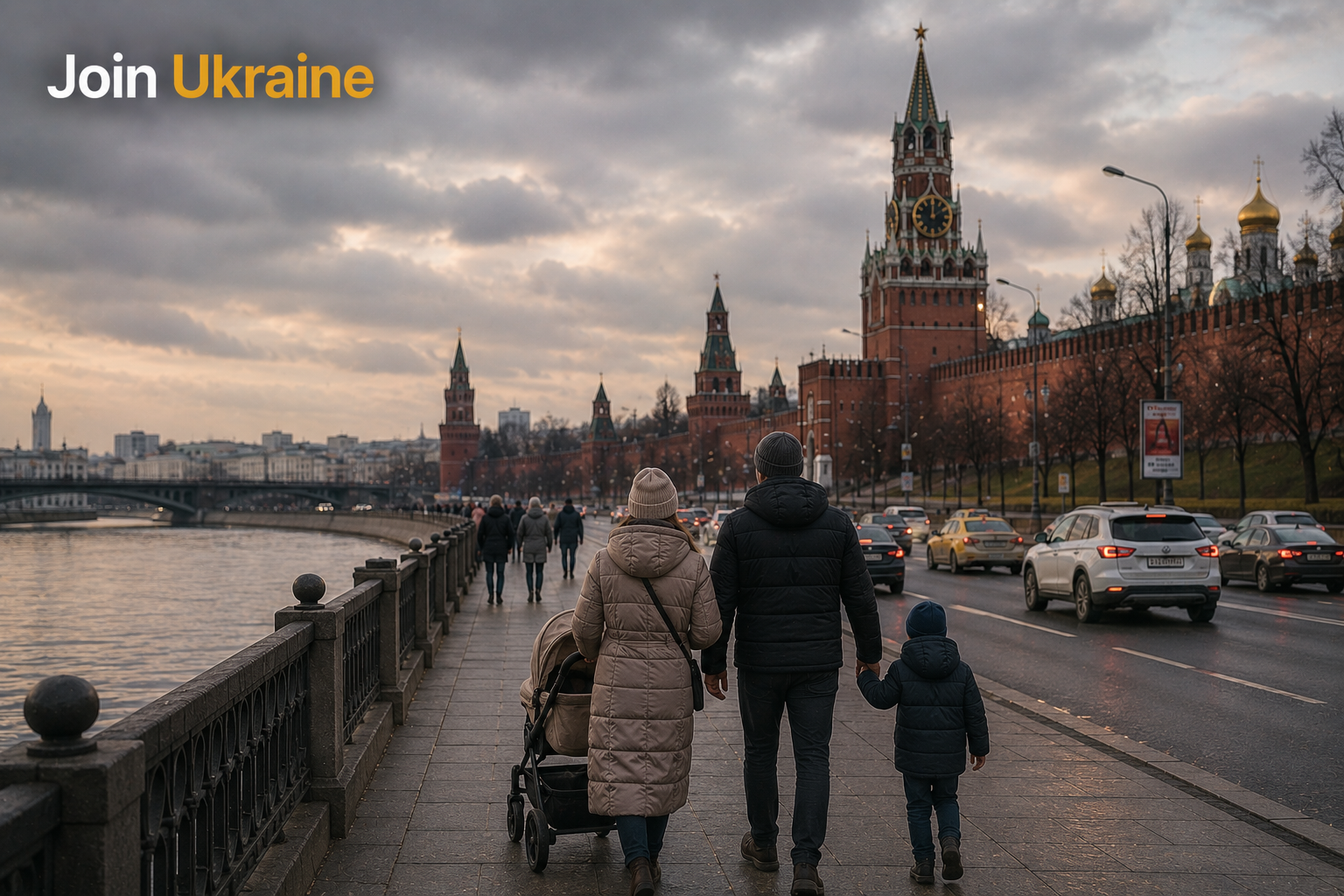
The Kremlin is promising money for having children, expanding benefits for large families, and making a show of “caring” for pregnant students and schoolgirls. The sums involved are enormous: by 2030, the national “Family” project is planned to receive funding comparable to two annual Ukrainian state budgets in terms of expenditure.
This money is going toward measures intended, in one way or another, to boost the birth rate — from subsidized mortgages for young families to propaganda promoting large families.
But there is a problem. Our monitoring of two popular social networks in Russia — Telegram and VKontakte — conducted in early 2026 shows that absurd legislative initiatives and intrusive demographic propaganda are openly irritating the Russian population. A policy that the Russian authorities call “family support” is becoming yet another source of conflict between the state and society.
To wage aggressive wars in the future, the Russians need people above all. That is why it is critically important for us to understand how successful the Kremlin’s demographic programmes are.
More than two-thirds of humanity lives in countries where fertility is below the level needed for generational replacement. The problem of population decline has plagued Ukraine since independence, but it became catastrophic after the full-scale war and the mass migration it triggered. Ukraine’s total fertility rate has now fallen below one.
Our enemy is in a better position, but things are far from simple. In 2024, 1.22 million children were born in Russia, one of the lowest figures in its modern history. By the end of 2025, Russia’s total fertility rate stood at 1.4 children per woman. The replacement level is 2.1.
After the invasion of Ukraine, this problem took on strategic importance for the Kremlin. Massive battlefield losses and the exodus of young people have turned the Soviet-era slogan “women will give birth to more” into a new political priority.
Just recently, Putin once again stated that “the long-term task is to preserve and increase the Russian people.” Fertility rates in the regions have also been incorporated into assessments of governors’ performance. Senior Russian officials, including Federation Council Speaker Valentina Matviyenko, echo the message: “to successfully ensure economic and social development, develop our country and ensure security, there need to be many more Russians. … A person’s success should be measured not by how much money they earn or what car brands they drive, but by how many children their family has.” Such statements are not isolated. Virtually every Russian pro-government figure periodically stresses the need to “have more children.”
Russia has sufficient resources to actively shape its demographic policy. The Kremlin has a broad range of tools at its disposal to increase fertility — from financial incentives to outright bans.
There are plenty of “carrots”: maternity capital, family mortgages, tax benefits, support for large families, and more.
The Kremlin is not sparing money for the “production” of new soldiers. Between 2025 and 2030, 17.9 trillion rubles (more than $200 billion) are planned for the national “Family” project, including 3.2 trillion rubles ($38 billion) in 2026 alone. Most of the programme consists of various financial incentives and benefits for families, including mortgages at reduced rates and maternity capital. Yet the Russian authorities understand that this is not enough. The project’s target is to raise the total fertility rate to 1.593. That is still far below the replacement level of 2.1.
For those who are not persuaded by financial incentives, the Russian authorities have a “stick” in the form of pro-natalist propaganda and various restrictions. These include Putin’s law banning the “propaganda of refusing to have children,” penalties for “inducing” someone to have an abortion, a ban on private clinics performing abortions, and, more recently, discussions in the State Duma and the Russian Orthodox Church about requiring a husband’s consent for his wife to have an abortion.
The state’s “concern” for citizens’ sexual health sometimes borders on the absurd. Among the latest government initiatives are referring women who do not plan to have children to psychologists, and sending men who enjoy saunas for semen analysis.
However amusing these innovations may look from the outside, through them the Kremlin is persistently pursuing its goal of overcoming the demographic crisis. At the same time, these initiatives are viewed critically — and sometimes even with hostility — by the population, creating yet another deep conflict within Russian society.
At Join Ukraine, we analysed discussions around childbearing in more than 700 Telegram and VKontakte communities across virtually all regions of Russia. The scale of the sample allows us to see both individual outbursts of discontent and a clear broader social trend.
The greatest wave of outrage was triggered by statements about payments to pregnant students and schoolgirls: 72% of reactions on Telegram were negative, while only 3% were supportive.
This kind of “support” was seen not as assistance to young women, but as encouraging early pregnancy at the expense of education and professional development.
Disgruntled social media users asked, “And when are they supposed to study?”, while others wondered: “Are women being pushed to have children instead of pursuing careers? And what happens if the marriage doesn’t work out? Will the state take care of the children? No, it won’t.”
Abortion restrictions ranked second in terms of negative sentiment. Users were particularly concerned by a proposal under which a married woman would be allowed to terminate a pregnancy only with her husband’s consent.
For example, one post in a Rostov public group received 1,473 negative reactions, while another similar post in a Voronezh group received 2,023. Commenters pointed to overcrowded orphanages and argued that banning abortions does not eliminate the reasons why women seek them.
Russians also strongly disliked the idea, proposed by their Ministry of Health, of pressuring women to become pregnant with the help of psychologists. Posts about introducing mandatory consultations for women who say they do not plan to have children, published in March 2026, received tens of thousands of shares and were met with almost entirely negative reactions.
Purely economic programmes did not generate much enthusiasm either. Posts about family mortgages were predominantly negative. The main reason was that the programme is becoming increasingly inaccessible to Russians due to constant changes to its terms and rising housing prices.
Russians reacted relatively calmly to posts about maternity capital, although attempts by the authorities to restrict how these funds can be used also drew sharp criticism from commenters.
The main basis for social media users’ criticism of the Kremlin’s demographic initiatives was distrust of the authorities and a belief in their hypocrisy, reflected in the sarcastic call: “Have children yourselves!” This argument accounted for roughly a quarter of substantive comments on Telegram and VKontakte.
Next came entirely mundane arguments: poverty, high prices and unaffordable housing. Commenters also condemned the cynicism of calls to have more children while schools, maternity wards and outpatient clinics are systematically being closed and infrastructure remains underdeveloped.
A xenophobic narrative was also prominent — a fairly predictable consequence of years of state propaganda that has taught Russians to look for scapegoats among migrants and other “outsiders.” Nearly one in seven substantive comments on Telegram and VKontakte argued that child-related benefits were supposedly going to the “wrong” people.
Direct state interference in private life was mentioned less frequently, but consistently. Even more cautiously, users talked about the war: only 5.8% of comments on Telegram and 7.5% on VKontakte explicitly linked calls to have more children with the need to replenish the army and compensate for human losses in the “special military operation.” Yet given the censorship and repression prevailing in Russia, even these figures are significant.
Women’s rights were mentioned least of all. One could joke that women’s rights in Russia are so reliably protected by the state that women themselves simply aren’t issued any. But seriously, the reason lies in the scale of “traditional values” propaganda and religious pressure, as well as the dominance of patriarchal notions of the family, particularly outside Russia’s largest cities.
Knowing your enemy means trying to stay at least one step ahead. That is why Russia’s demographic policy has not only a social dimension for Ukraine, but also a direct security dimension.
Behind campaigns to increase fertility and promote large families lies the Kremlin’s desire to preserve its human and mobilization resources for future wars. The Russian authorities themselves make no secret of linking population size to military power, national strength and the country’s status.
Even after the current war ends, Russia is likely to remain imperial and aggressive for as long as it continues to exist as a unified political system. Rebuilding its mobilization potential through new generations could eventually result in another war for Ukraine. Meanwhile, Ukraine’s population is shrinking rapidly due to wartime losses, migration and low fertility.
We do not have time for complacency. We need to prepare now for a possible new confrontation by combining stronger defence with support for families, the return of citizens, economic development, and the creation of a country whose people will not be afraid to build their future here.
The Kremlin is actively trying to address its demographic crisis, but it appears to be more successful at deepening the conflict between the population and the authorities. Our task is even harder. At the very least, we must avoid repeating Russia’s mistakes in responding to demographic challenges.
<-
Back